Legend & origins
The empire that refused to die
When Nineveh fell in 612 BC and the world's first great empire burned, its farmers stayed on the land, kept their name, and waited. Assyrian tradition never stopped calling the plain north of Mosul by its oldest title: the country of Ashur.
Among the first peoples to adopt Christianity — legend credits the apostle Thomas and his disciples Addai and Mari — the Assyrians built the Church of the East, a church that at its medieval height ran missions along the Silk Road to India and Tang-dynasty China while Europe's cathedrals were still young. Its scholars translated Greek philosophy into Syriac and then Arabic, feeding the Islamic golden age and, through it, the European renaissance.
History has split one people into several names. The Chaldeans — today the largest branch — are those who entered communion with Rome from 1552, centred on Alqosh, Telkaif and Baghdad. The Assyrian Church of the East continues the ancient non-Chalcedonian line, with its patriarchate now back in Erbil. The Syriac Orthodox and Syriac Catholics of Tur Abdin, Qamishli and Mosul carry the West Syriac rite. Names divide them; the Aramaic language and the memory of Nineveh bind them.
What sets them apart
Carriers of the world's longest continuities
What distinguishes the Assyrians is not one custom but an unbroken chain: language, calendar, monastery and name, running from the Iron Age into the present tense.
The language of Jesus, at home
Suret and Turoyo, modern Aramaic, are still cradle tongues. A child in Alqosh or Södertälje learning them from her grandmother holds open a linguistic line unbroken since the Iron Age — UNESCO lists both as endangered.
Akitu, year 6774
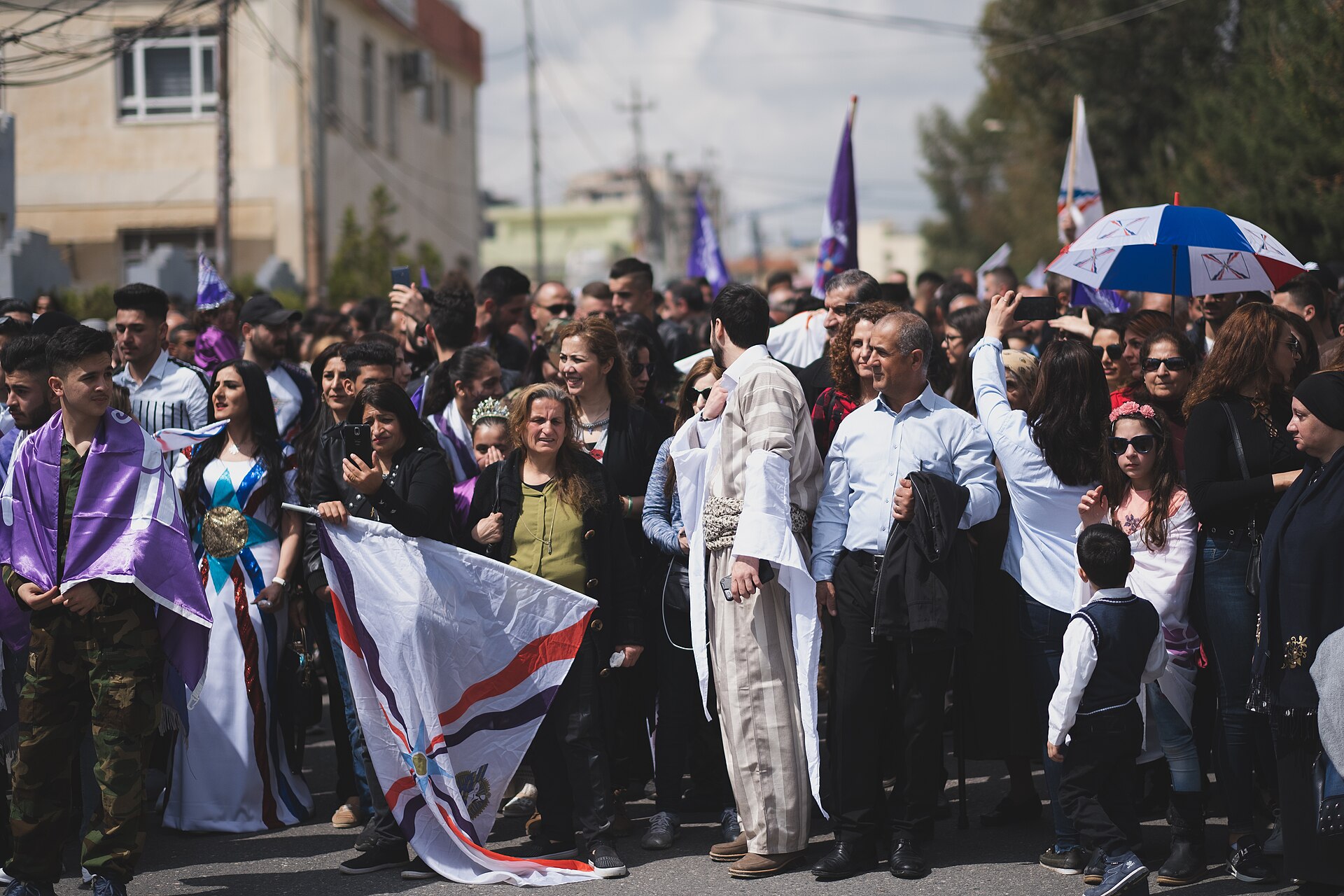
The New Year festival on 1 April descends from the spring rites of Babylon and Nineveh; the Assyrian calendar counts from 4750 BC, the traditional founding of Assur.
Cliff monasteries
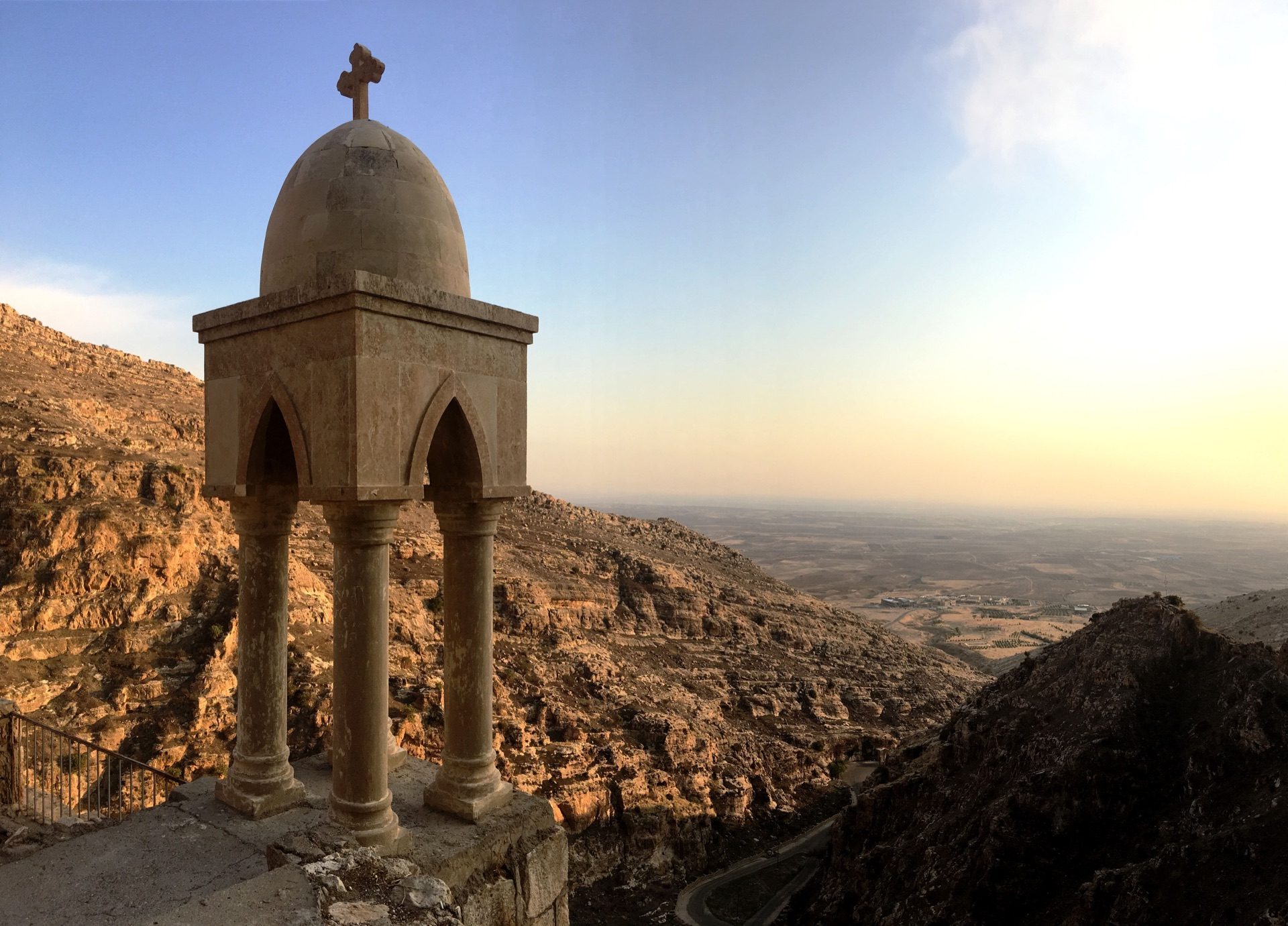
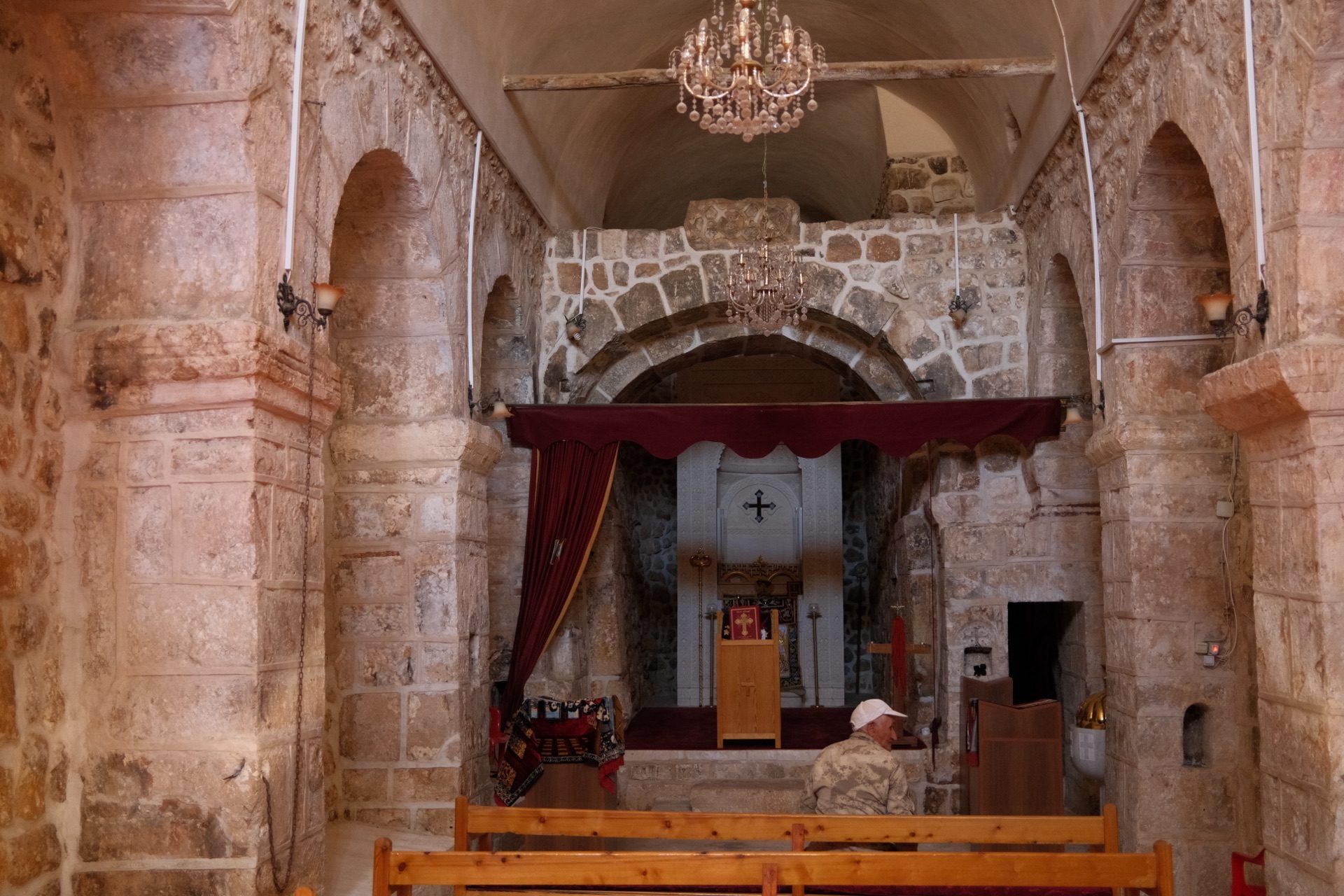
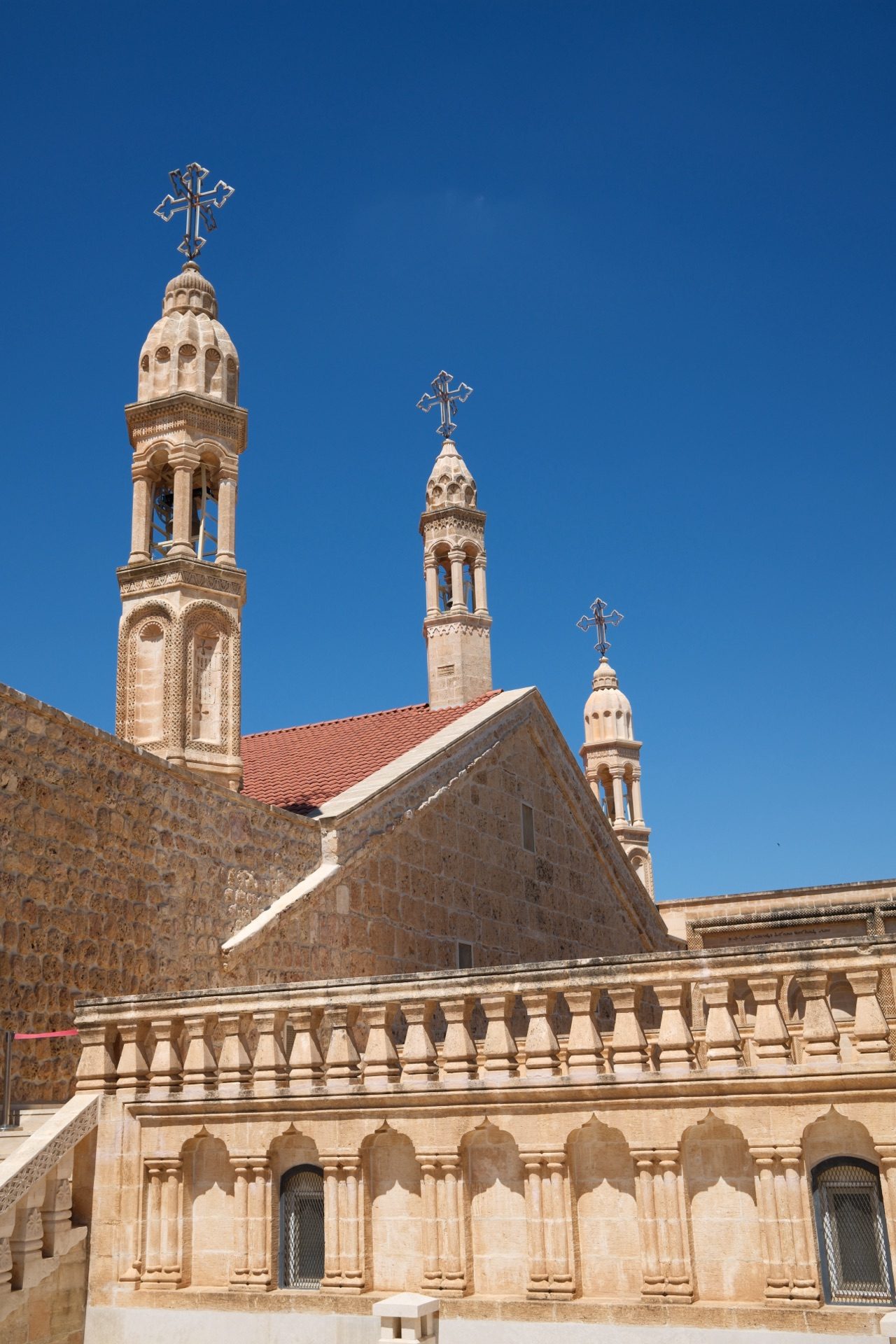
Rabban Hormizd, carved into the rock above Alqosh in the 7th century, and Mar Mattai on its mountain were libraries and refuges at once — their walls dense with Syriac inscription in the flowing Estrangela script.
Sub-groups, one people
Chaldean Catholic, Assyrian Church of the East, Ancient Church of the East, Syriac Orthodox and Syriac Catholic: confessional names born of church politics, laid over a single Aramaic-speaking people.
1915 — 2014
Sayfo, Simele, and the letter nūn
The community's modern history is punctuated by catastrophe. In 1915 — the Sayfo, “the Sword” — Ottoman forces and allied tribes killed an estimated 250,000 Assyrians alongside the Armenian genocide. In 1933 the new Iraqi state massacred some 3,000 villagers at Simele — the atrocity that moved Raphael Lemkin to begin the legal work that coined the word “genocide.”
In 2014 ISIS took Mosul and painted the Arabic letter nūn — for “Nazarene” — on Christian homes. Over 100,000 Assyrians fled the Nineveh Plains overnight; the bulldozing of ancient Nimrud followed. Towns like Qaraqosh and Alqosh have been partly rebuilt, but emigration continues, and the diaspora — Chicago, Detroit, Södertälje, Sydney — now far outnumbers the homeland.
We are not guests in Iraq. We are the reason it has a history.A sentiment common in Assyrian advocacy — the indigeneity claim
Geography
Where they live
Assyrian/Chaldean/Syriac population centres. Zones are indicative concentrations, not boundaries.
Through time
Timeline
- c. 2500 BCThe city of Assur rises on the Tigris, giving its name to a people and their god.
- 612 BCFall of Nineveh. The empire ends; the Assyrian population remains on its land under successive rulers.
- 1st–3rd c. ADChristianisation. Mesopotamia becomes a heartland of early Christianity; the Church of the East takes shape outside the Roman world.
- 1552The Chaldean union. Part of the Church of the East enters communion with Rome — the origin of today's largest branch.
- 1915Sayfo — “the Sword.” Ottoman forces and allied tribes kill an estimated 250,000 Assyrians in Anatolia and Persia.
- 1933The Simele massacre. Iraqi forces kill some 3,000 Assyrian villagers; the crime shapes the very concept of genocide.
- 2014ISIS takes the Nineveh Plains. 100,000+ flee overnight; Nimrud is bulldozed. Partial return follows liberation in 2017.
- TodayThe balance tips. Perhaps a tenth of the world's Assyrians remain in the Middle East; the rest sustain the culture from abroad.
A people now mostly elsewhere
Estimated population
Regional figures are post-war estimates from church bodies and minority-rights reporting; Syria's community has fallen steeply since 2011. The worldwide diaspora estimate spans 2–4 million.
View as table
| Where | Estimate |
|---|---|
| Iraq | ≈200,000 |
| Syria | ≈80,000 |
| Lebanon | ≈40,000 |
| Turkey | ≈25,000 |
| Iran | ≈15,000 |
| Diaspora | ≈2.5 million |
What they gave the region
The translators of civilisation
No community in this atlas has moved more knowledge between worlds. Syriac scholars translated Aristotle and Galen into Arabic for the Abbasid court, seeding the Islamic golden age that later re-lit Europe; the Church of the East carried writing, medicine and astronomy along the Silk Road as far as China. Modern Iraq's printing, hotel and music trades were disproportionately Assyrian; Baghdad's first newspapers and Iraq's beloved mid-century singers owed much to the community.
The living gift is daily: Akitu processions that put 6,700 years of continuity on the street each April, kleicha — Iraq's national cookie, baked to Assyrian recipes at every feast — and a liturgical music tradition, chanted in Aramaic modes, that predates Gregorian chant.
Looking forward
A homeland the size of a province
Assyrian politics now concentrates on one achievable thing: a secure, self-administered Nineveh Plains within federal Iraq, where Qaraqosh and Alqosh have already rebuilt cathedrals and schools. Success would mean the world's oldest Christian heartland survives as more than a museum; failure accelerates the drift already visible — a people whose future is decided in Chicago, Södertälje and Sydney parish halls.
The wild card is the diaspora itself: wealthy, organised and newly invested in homeland schools, land purchases and Aramaic-revival apps. Assyrians have outlived the empire that named them by twenty-six centuries; betting against another century would be brave.
The emblem
The star of Shamash
The four-pointed star with waved rays belonged to Shamash, Mesopotamian god of the sun and of justice. It blazes at the centre of the modern Assyrian flag — a deliberate reach across three thousand years, binding a Christian people to their pre-Christian civilisation.