Legend & origins
The Nart sagas and the year of the ships
Circassian memory keeps two epics. The old one is the Nart sagas — tales of giant heroes, of Sosruquo who stole fire, of Satanaya the wise mother — shared with the whole Caucasus and older than any scripture. The new one is 1864: the year of the ships.
After a century of Russian conquest wars, the Tsar's generals resolved the 'Circassian question' by expulsion: villages burned, populations driven to the Black Sea beaches, and hundreds of thousands packed onto Ottoman boats. Perhaps a million and a half people were deported or died — of drowning, typhus and hunger on the shores — in what Circassians commemorate every 21 May as genocide. The Ottomans settled the survivors along their inner frontiers: Anatolia above all, then down the pilgrim road through Syria and Transjordan.
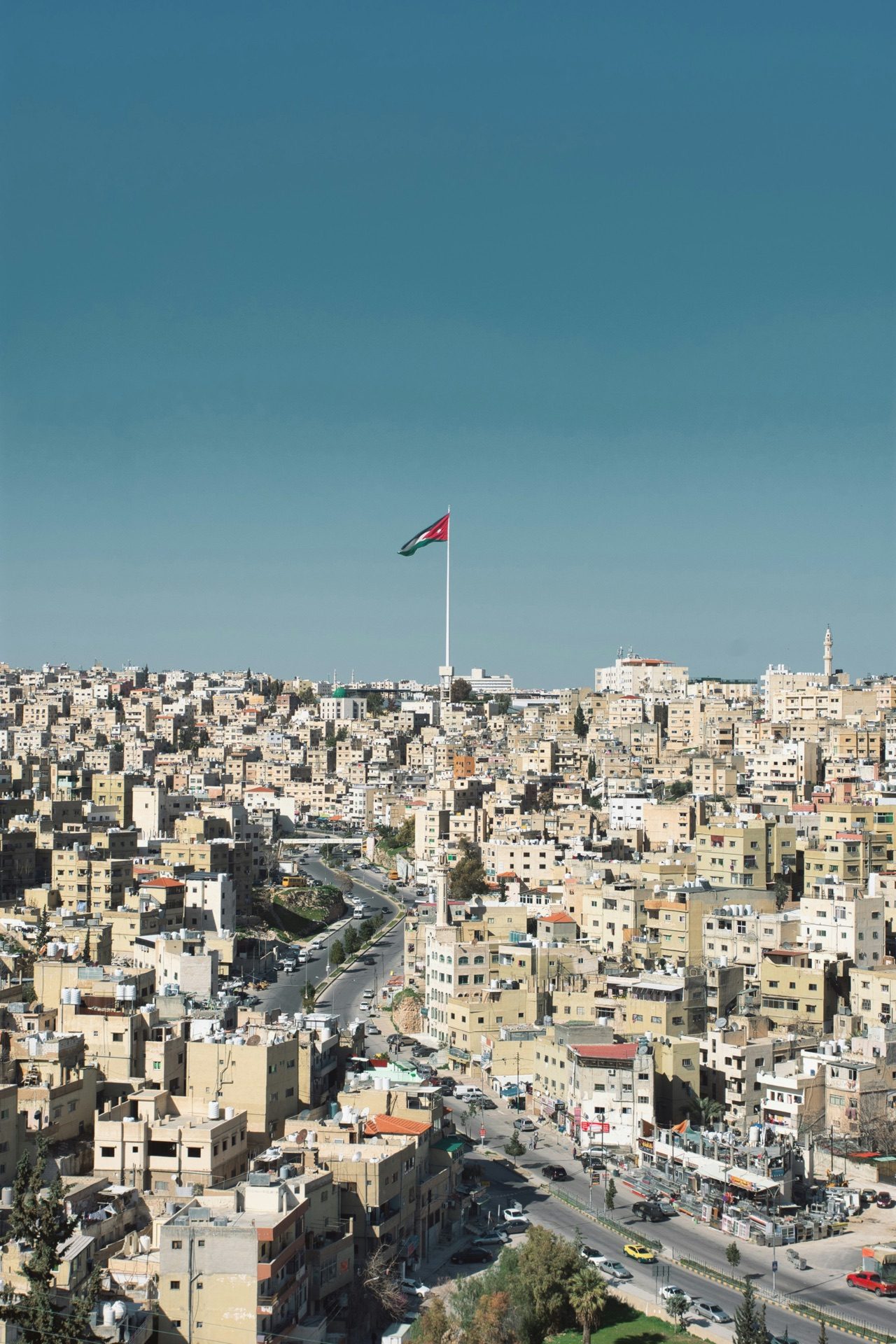
There the exiles built anew with a soldier-farmer's discipline. When Circassian settlers raised their houses among Roman ruins by a stream in 1878, the place was called Amman; it had been uninhabited for centuries. They drained marshes in the Golan, founded Quneitra, and hired their loyalty to every ruler who kept faith with them — a Circassian honour guard has protected Jordan's kings since the emirate's first day.
What sets them apart
Exile administered by a code of honour
What holds Circassians together across five states is less religion than the khabze — the unwritten law of conduct that governs everything from posture to marriage.
The khabze
An honour code covering hospitality, deference, silence before elders and the bearing of the body — Circassians say a man's khabze is visible from across a street.
The cherkeska and the dance
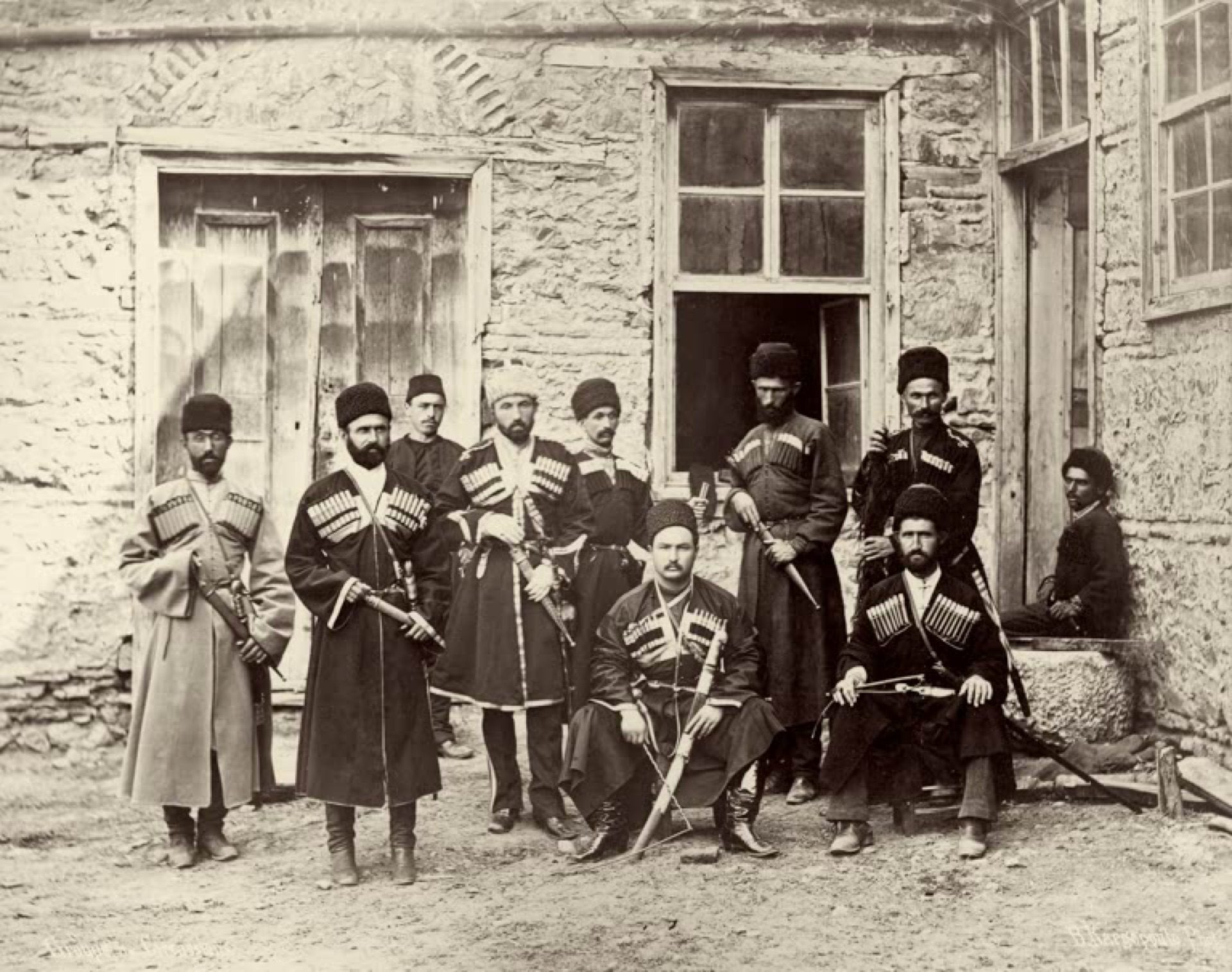
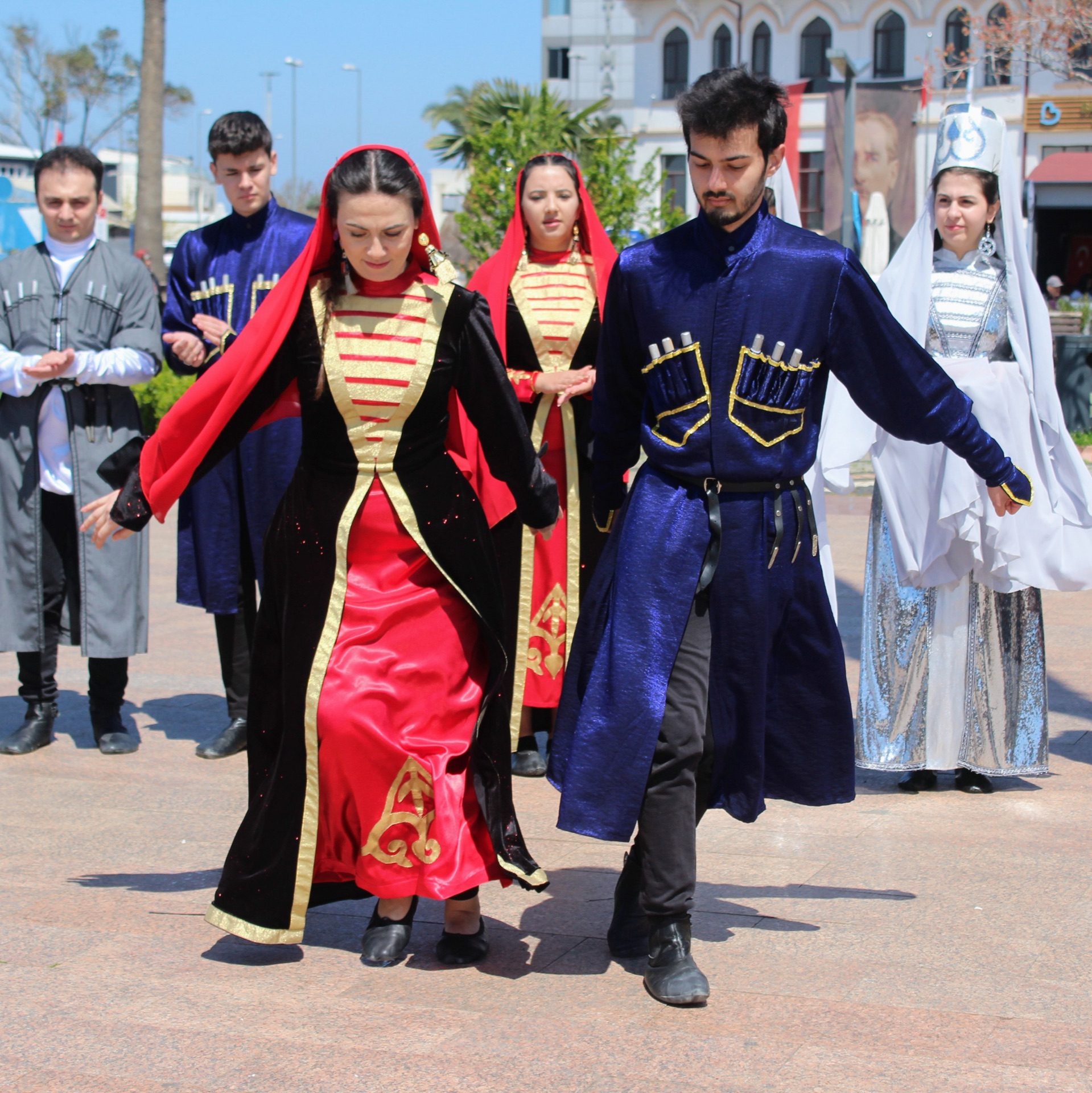
The fitted black coat with silver cartridge holders, and the couple dances — the man a hawk circling, the woman gliding as if on water — carry the Caucasus into every wedding hall.
Guards of kings
From Ottoman gendarmes to the ceremonial guard of Jordan's Hashemite court, the community's military reputation became its social contract in exile.
21 May
The commemoration of the 1864 deportations — black flags, sea-ward processions — binds the diaspora to a homeland cause: recognition, and the right of return to the Caucasus.
1878 — today
Founders of Amman, farmers of ruins
The Levantine communities took different roads. Jordan's Circassians — perhaps 100,000 — became the kingdom's administrative aristocracy: ministers, generals, the royal guard, with reserved seats in parliament; Amman's founding families still hold their quarter names. Syria's community, centred on Quneitra and the Golan, was shattered twice — first when Israel took the Golan in 1967 and Quneitra was later razed, then in the civil war, when thousands used Russia's diaspora-return laws to go back to the Caucasus their ancestors were expelled from: exile reversing after 150 years.
Israel's two Circassian towns, Kfar Kama and Rehaniya — about 5,000 people — are the community's linguistic miracle: Adyghe-language schooling, drafted men, and the best-preserved dialect outside the Caucasus. Turkey holds the great mass, two million or more of Circassian descent, largely assimilated but stirring: associations, language courses and 21 May marches have made 'Çerkes' a public identity again. UNESCO lists both Circassian languages as endangered everywhere — the community's next war is with the dictionary.
We built Amman among the ruins — as the ruins of our own country smoked behind us.On the Circassian founding of Jordan's capital, 1878
Geography
Where they live
The Circassian exile arc: Anatolia and the Levant line of 1864–78 settlement, with the Caucasus homeland beyond.
Through time
Timeline
- 1763–1864The Russo-Circassian war. A century of conquest ends in the destruction of Circassia.
- 1864The year of the ships. Mass deportation across the Black Sea; hundreds of thousands die. Commemorated as genocide every 21 May.
- 1878Amman founded. Circassian settlers build among the Roman ruins; Quneitra and the Golan villages follow.
- 1921The Hashemite compact. Circassians provide the new Emirate of Transjordan its guard, officers and administrators.
- 1967 / 1974The Golan lost, Quneitra razed. Syria's Circassian heartland is emptied; families scatter to Damascus and abroad.
- 2011–War and return. Syrian Circassians flee; Russia's return programmes carry thousands back to the Caucasus.
- TodayThe language front. Adyghe and Kabardian are endangered everywhere; schools in Kfar Kama and Amman fight the tide.
The exile's arithmetic
Estimated population (descent)
Descent-based estimates; active identity and language run far lower. Syria's figure has fallen steeply since 2011. The Caucasus republics hold ≈700,000 Circassians — the homeland as diaspora's mirror.
View as table
| Where | Estimate |
|---|---|
| Türkiye | ≈2 million |
| Jordan | ≈100,000 |
| Syria | ≈50,000 |
| Israel | ≈5,000 |
| Diaspora & Caucasus | ≈800,000 |
What they gave the region
Founders, guards, choreographers
The Circassian gift begins with a capital: Amman, founded by exile-settlers in 1878, and the Golan's Quneitra likewise. Jordan's army, police and court protocol carry Circassian fingerprints a century on; the kingdom's ceremonial guard in black cherkeska is the community's living signature. Circassian dance ensembles set the standard for folk performance across the Levant, and the khabze's code of courtesy quietly shaped urban Jordanian manners.
Even the region's costume history owes them: the cherkeska's cartridge-chest design was adopted by half the Caucasus and Cossack world — elegance engineered for horseback.
Looking forward
A people between two homelands
Circassian futures now run on two tracks. In the Levant, prosperity and assimilation thin the language even as associations, Adyghe classes and Kfar Kama's schools fight back; Jordan's community keeps its reserved seats and royal trust. Northward, Russia's diaspora-return programmes and the centenary politics of 1864 keep the Caucasus option alive — Syrian Circassians fleeing war chose it by the thousand.
UNESCO lists both Circassian languages as endangered; the community's own metric is blunter — whether the wedding dances still find dancers. On current evidence, from Amman's clubs to Galilee's schoolyards, they do.
The emblem
Three arrows beneath the stars
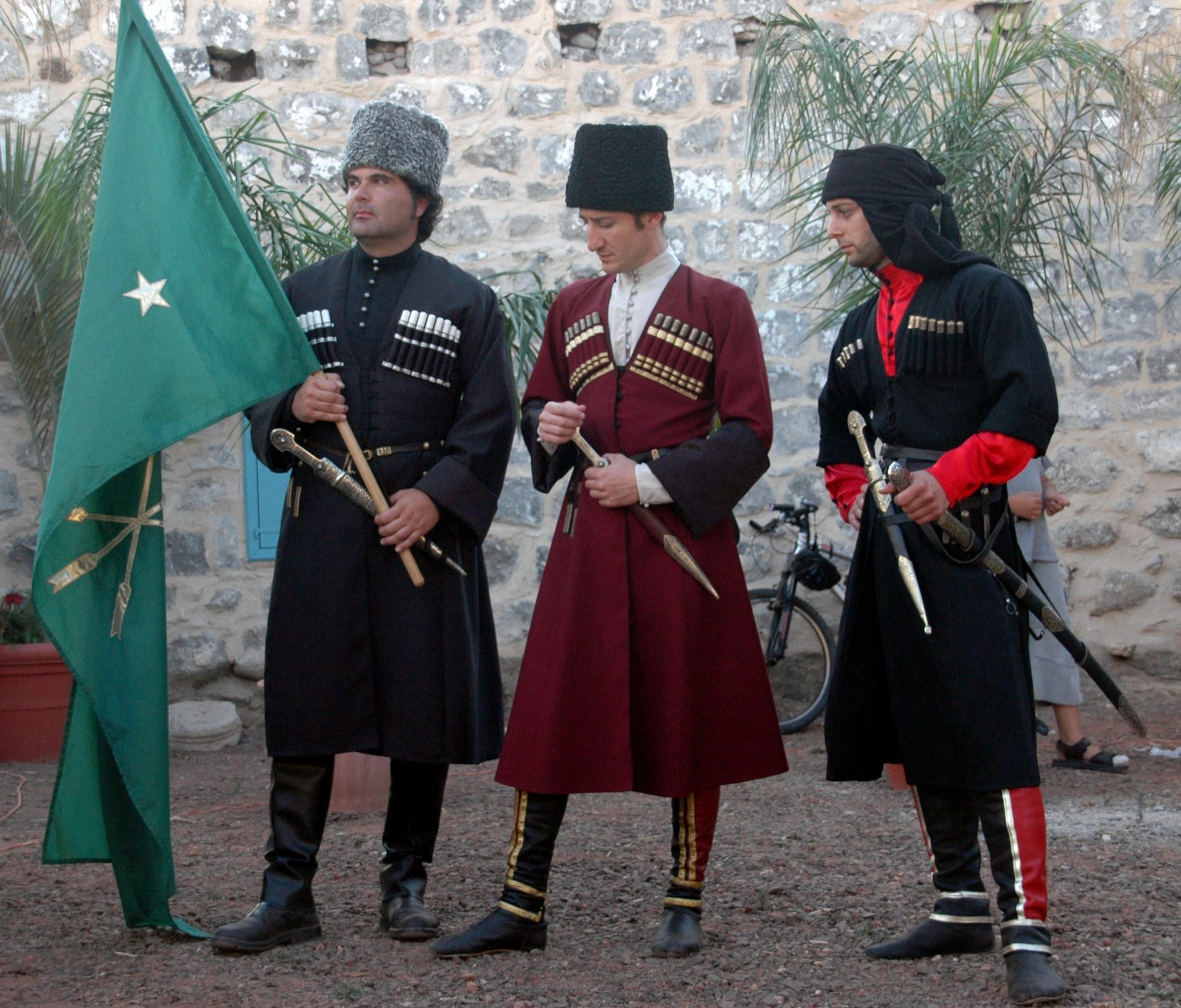
The Circassian flag — twelve gold stars over three crossed arrows on green — was raised during the last unification of the tribes in the 1830s: twelve principalities, and arrows enough to defend them. It flies today from Amman's clubs to Kfar Kama's schoolyard.
Go deeper