Legend & origins
The laughing child and the two spirits
Legend says Zarathustra laughed at his own birth — the only infant ever to greet the world so — because he saw the long war he was born into: Ahura Mazda, the Wise Lord, against the Lie, light against darkness, and humanity free to choose its side.
From that vision, some three thousand years ago on the Iranian plateau, flowed ideas the world now takes for granted: one supreme God, a cosmic struggle of good and evil, judgment after death, a saviour to come, a renovation of the world at the end of time. Persia's empires carried the faith from the Nile to the Indus; scholars trace its fingerprints across Judaism, Christianity and Islam alike.
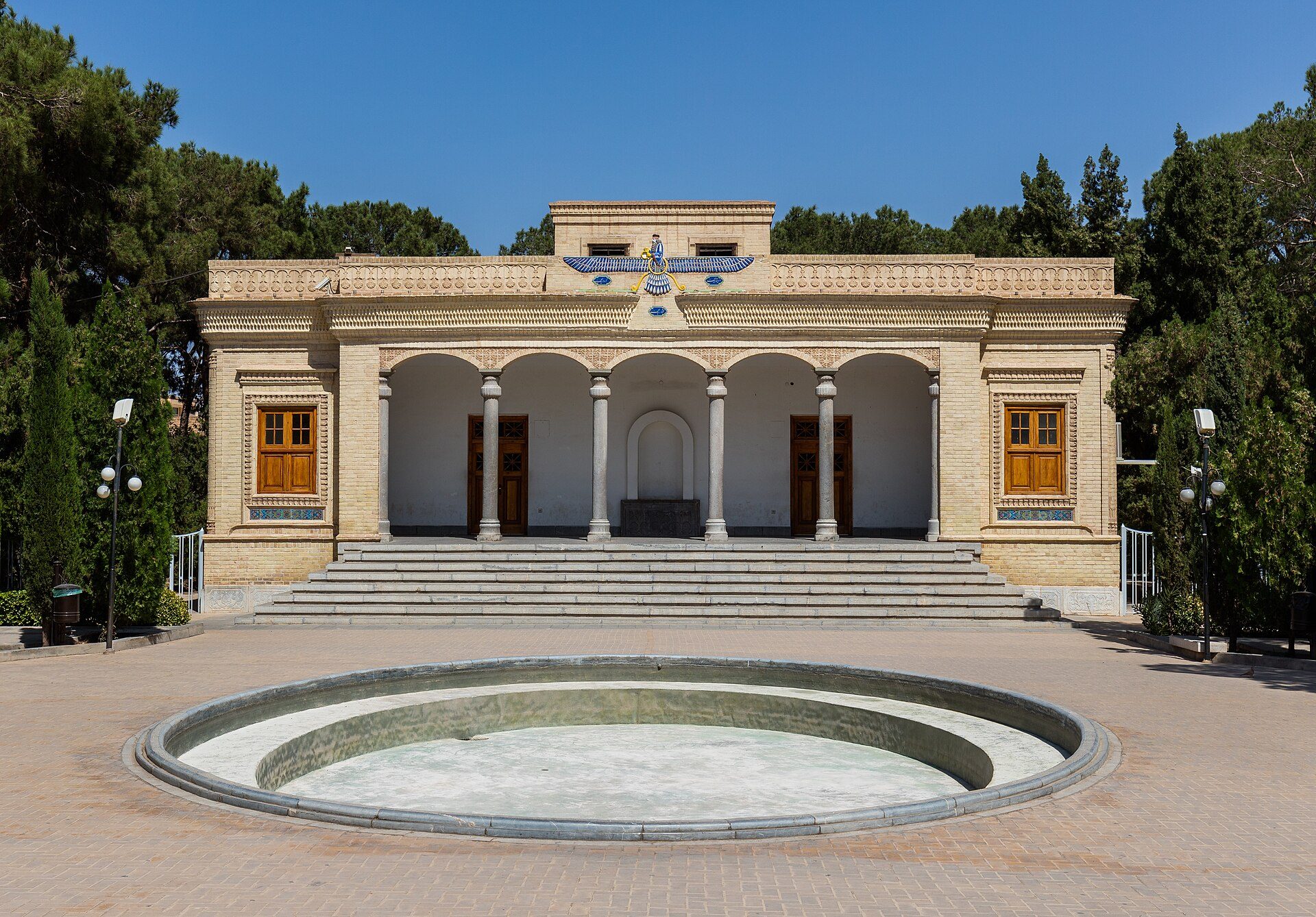
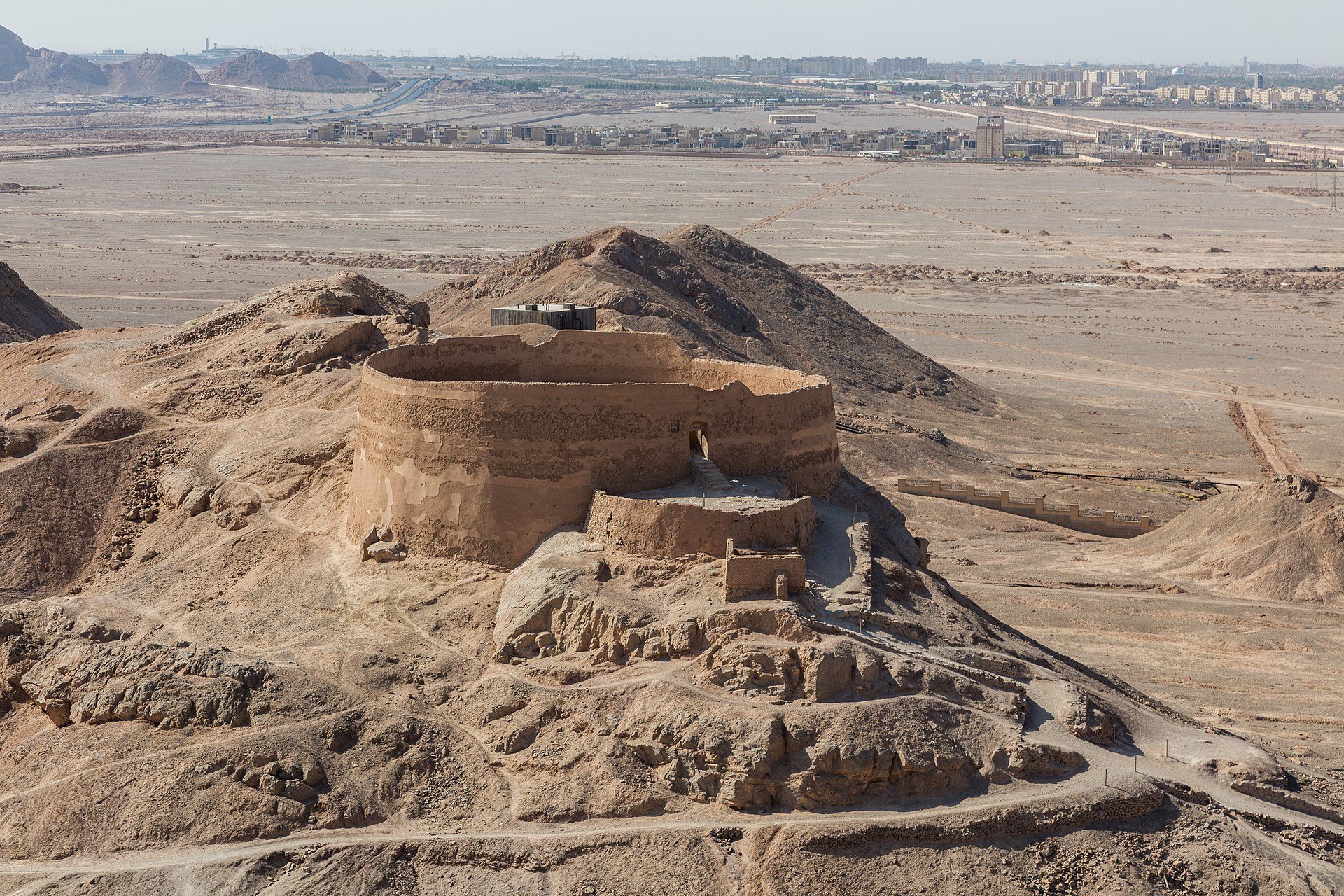
The Arab conquest of the 7th century began the long ebb. Over centuries of jizya, conversion pressure and periodic massacre, the community contracted to the desert cities of Yazd and Kerman — remote enough to be left mostly alone — while one shipload of emigrants, by tradition in the 10th century, sailed for India to become the Parsis. In Iran the faithful kept the fires burning: the Atash Bahram of Yazd has, by tradition, burned continuously for over 1,500 years.
What sets them apart
The religion of the elements
Zoroastrian practice treats creation itself — fire, water, earth, air — as sacred and vulnerable, and organises life around keeping it pure.
The ever-burning fire
Fire is not worshipped but venerated as the visible form of truth. Temple fires are ranked by consecration; the highest, the Atash Bahram, is assembled from sixteen fires including lightning, and never allowed to die.
Nowruz and the sadeh fires
The Persian new year the whole region now celebrates is Zoroastrian in origin; midwinter Sadeh, with its great communal bonfire, survives as the community's most visible public feast in Iran.
Good thoughts, good words, good deeds
The entire ethics compresses into the threefold formula — humata, hukhta, huvarshta — woven into the kusti cord every initiate ties and unties in daily prayer.
The sudreh and kusti
At initiation (sedreh-pushi) every child receives the sacred white shirt and the 72-thread lambswool cord — 72 for the chapters of the Yasna liturgy — worn for life beneath ordinary clothes.
Iran today
A tolerated remnant, a quiet pride
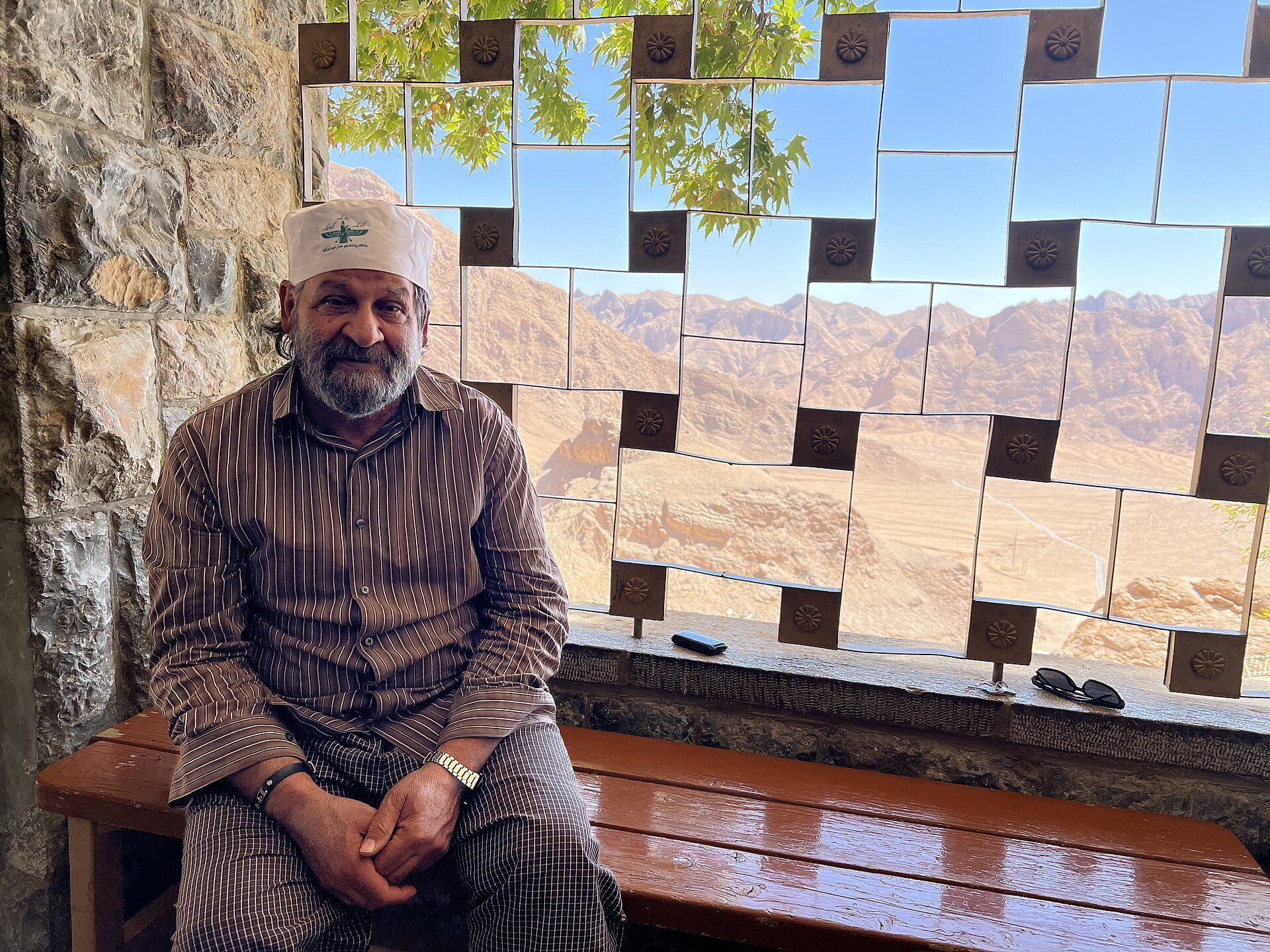
The Islamic Republic recognises Zoroastrians as a protected religious minority with a reserved seat in parliament — a status that brings real space (temples, schools, associations) and real ceilings: exclusion from senior office, inheritance law that favours Muslim converts, and the steady pull of emigration. The official census counts around 25,000; community estimates run somewhat higher, and Tehran now rivals Yazd as the centre of Zoroastrian life.
Yet the faith's cultural stock inside Iran has rarely been higher. Many Iranians — of all confessions — have embraced Nowruz, Yalda, Sadeh and the Faravahar symbol as emblems of pre-Islamic national identity; the winged figure is among the most common pendants in Iranian jewellery shops. The community that survived thirteen centuries as a remnant finds itself, unexpectedly, the custodian of symbols an entire nation borrows.
There is but one path: the path of Truth. All else is no path.Attributed to Zarathustra — the Gathas
Geography
Where they live
Zoroastrian Iran: the Yazd–Kerman desert axis and the modern pull of Tehran.
Through time
Timeline
- c. 1200–1000 BCZarathustra teaches. The Gathas are composed on the Iranian plateau; dating remains scholarly guesswork.
- 550–330 BCFaith of an empire. The Achaemenids rule from the Nile to the Indus under Ahura Mazda's wing.
- 224–651 ADSasanian orthodoxy. Zoroastrianism becomes a state church with a high priesthood — and its own persecutions of others.
- 651The Arab conquest. The last shah falls; thirteen centuries of minority life begin.
- c. 936The sailing to India. By tradition, emigrants from Khorasan land in Gujarat — the origin of the Parsis.
- 1854The Parsi rescue. Bombay Parsis send emissaries who eventually win abolition of the jizya for Iran's Zoroastrians.
- 1979Revolution. Recognised-minority status under the Islamic Republic: one MP, real protections, real ceilings.
- Today25,000 and the symbols of a nation. A shrinking community whose festivals and Faravahar all Iran has adopted.
The remnant and the sea
Estimated population
Iran's 2016 census counted ~23,000; community claims reach 60,000. The worldwide figure is dominated by India's Parsis (~50,000) and growing North American communities.
View as table
| Where | Estimate |
|---|---|
| Iran | ≈25,000 |
| Diaspora | ≈100,000 |
What they gave the region
The faith the region borrowed from
Zoroastrian ideas are the region's hidden operating system: one God, judgment, heaven and hell, a coming saviour, the world's final renewal — scholars trace each across Judaism, Christianity and Islam. The living gifts are Iranian civilisation's calendar of joy: Nowruz itself, Yalda's midwinter vigil, Chaharshanbe Suri's fire-jumping, Sadeh's great bonfire — all Zoroastrian survivals the whole nation now keeps.
Even the region's gardens carry the imprint: the Persian garden's fourfold paradise plan — the very word 'paradise' — descends from Zoroastrian sacred landscaping.
Looking forward
Small flame, strong draught
Numerically the Iranian community keeps shrinking — emigration to North America outpaces births, and conversion in is illegal. Yet its cultural stock has never been higher: young Iranians wear the Faravahar as quiet dissent, Yazd's temples draw growing pilgrim-tourism, and the diaspora funds restoration the state permits because heritage is good politics.
The deeper question is whether the faith reopens its doors: diaspora communities increasingly accept converts and intermarried families, a quiet revolution Iran's priesthood resists. The fire has been carried before; the next carriers may pray in English and Persian both.
The emblem
The eternal flame
The fire altar — a flame in a raised brazier — is the oldest emblem of the faith, older than the Faravahar the modern world knows better. Fire is truth made visible; the community's whole history can be told as the custody of a flame.
Go deeper